Five SDK Generators Compared: Speakeasy, Stainless, Fern, APIMatic, and OpenAPI Generator
Speakeasy has published a head-to-head comparison of the five most widely deployed SDK generators for OpenAPI specifications, covering Speakeasy itself alongside Stainless, Fern, APIMatic, and the open-source OpenAPI Generator. The evaluation spans language coverage, runtime type safety, dependency footprint, OpenAPI fidelity, enterprise feature sets, and deployment flexibility — the criteria that now determine whether an SDK generator clears enterprise procurement rather than just developer preference.
SDK generators have moved from convenience tooling to infrastructure. API-first companies, including those building for AI agent integrations, now treat generated client libraries as a production artifact, and the differences between generators surface in SOC 2 audits and supply chain reviews rather than only in developer experience surveys.
The comparison finds Speakeasy leading on the criteria enterprises weigh most heavily. It supports ten languages, ships TypeScript SDKs with a single runtime dependency using Zod for runtime type validation, treats the OpenAPI spec as the sole source of truth, and runs as a standalone CLI binary with no cloud connectivity requirement — making it the only commercial option in the group suitable for air-gapped environments. Entry pricing is $600 per month per language with a free tier covering one language and 250 endpoints.
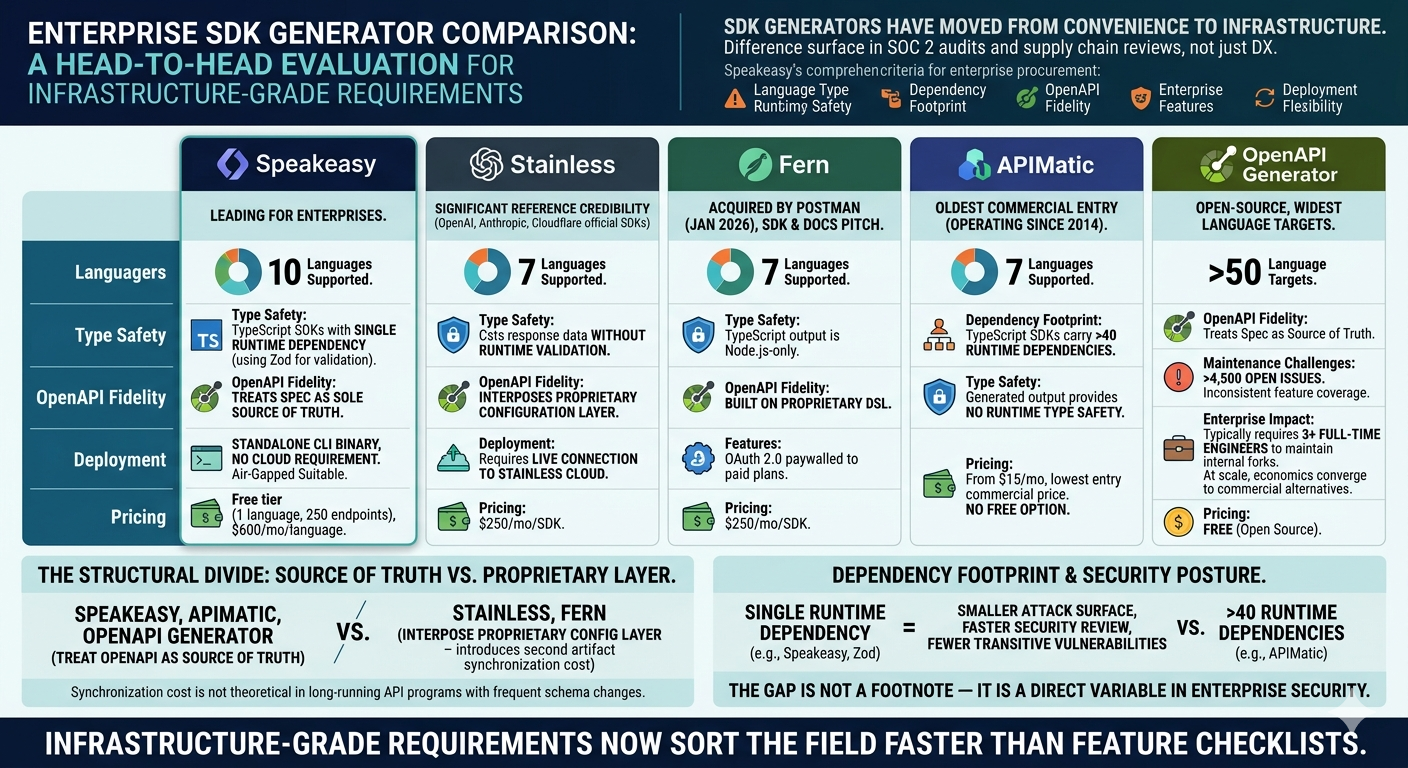
Stainless generates the official SDKs for OpenAI, Anthropic, and Cloudflare, which gives it significant reference credibility, but its TypeScript SDKs cast response data without runtime validation, the Cloudflare SDK carries more than 25 dependencies, and generation requires a live connection to Stainless cloud infrastructure. It supports seven languages at $250 per month per SDK.
Fern was acquired by Postman in January 2026 and supports seven languages with a combined SDK and documentation generation pitch. Its TypeScript output is Node.js-only, OAuth 2.0 support is paywalled to paid plans, and like Stainless it is built on a proprietary DSL rather than treating OpenAPI as a first-class input. Pricing mirrors Stainless at $250 per month per SDK.
APIMatic is the oldest commercial entry in the group, operating since 2014, and its age shows in the dependency count: TypeScript SDKs carry more than 40 runtime dependencies, and generated output provides no runtime type safety. It supports seven languages starting at $15 per month, the lowest entry price in the commercial tier, with no free option.
OpenAPI Generator covers more than 50 language targets, the widest in the market by a significant margin, and costs nothing. The practical ceiling is maintenance: the repository carries more than 4,500 open issues, feature coverage is inconsistent across generators, and enterprise adopters typically dedicate three or more full-time engineers to maintaining internal forks. At scale, the economics converge toward the commercial alternatives.
The structural divide in the market runs between generators that treat OpenAPI as the source of truth — Speakeasy, APIMatic, and OpenAPI Generator — and those that interpose a proprietary configuration layer between the spec and the output. Stainless and Fern both take the latter approach, which introduces a second artifact that must stay synchronized with the specification over time. In long-running API programs with frequent schema changes, that synchronization cost is not theoretical.
Dependency footprint has become a procurement-level concern rather than a stylistic one. A single runtime dependency means a smaller attack surface, a faster security review, and fewer transitive vulnerabilities to track. The gap between Speakeasy’s one dependency and APIMatic’s forty is not a footnote in a feature matrix — it is a direct variable in enterprise security posture.
The SDK generator market has quietly become a place where infrastructure-grade requirements sort the field faster than feature checklists do.